MANOTERRA decodes

November 2025

COTTON AND WATER STRESS

Manoterra decrypts the latest reports and news topics to help you grasp the essentials in less than 3 minutes of reading.

Cotton is the main raw material for the global textile industry, but it remains one of the most water-intensive fibers, often grown in areas already experiencing water stress.

WHAT IS WATER STRESS ?

This is the ratio of total water withdrawals to the renewable supply available in surface water and groundwater. The higher the ratio, the greater the competition between users (scale from 0 to 5).
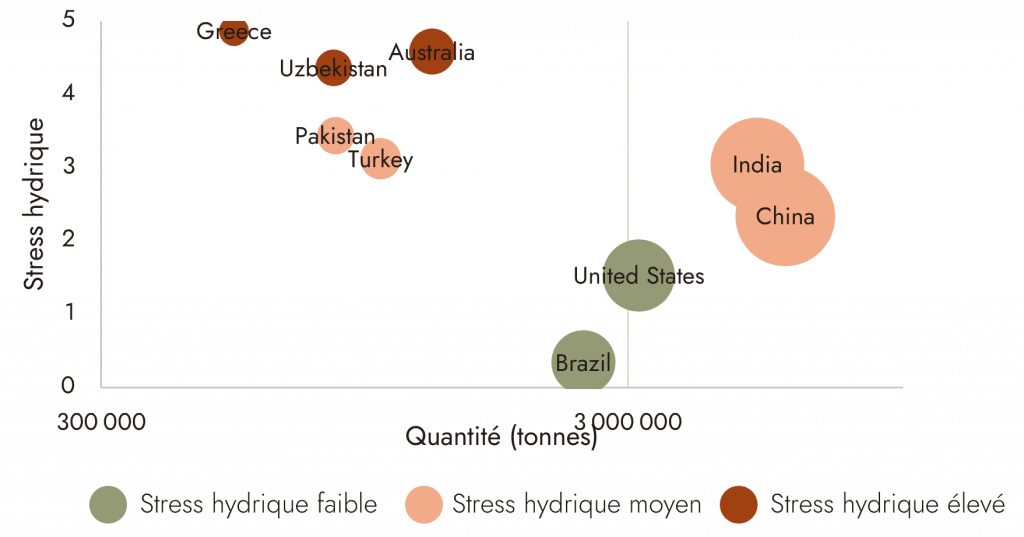
WHAT IS THE EXPOSURE TO WATER STRESS FOR THE MAIN PRODUCERS?

Cotton production and water stress

(bubble size = share of global production)​

NEW AGRICULTURAL PRACTICES

In order to meet crop water needs in a future disrupted by climate change and periods of limited water availability, regenerative agriculture practices exist that yield concrete results depending on the area:

  • Implementation of drip irrigation with mulching. Reduction of losses through evaporation and runoff, as well as stabilization of the temperature and humidity in the root zone. (arid zone)
  • Installation of probes. Control of the amount of water to be supplied based on soil moisture and intra-plot modulation.
  • Installation of partial root drying (PRD) irrigation. Alternating watering on either side of the root to trigger the plant's biochemical mechanisms, optimizing water absorption. (arid/semi-arid areas)

Better Cotton is the world's leading cotton sustainability program: it supports producers in improving water management, soil health, and working conditions, while striving to maintain quality and yields. Below is a concrete example of the reduction in water consumption per area in India in areas where the above practices and others have been implemented: ​
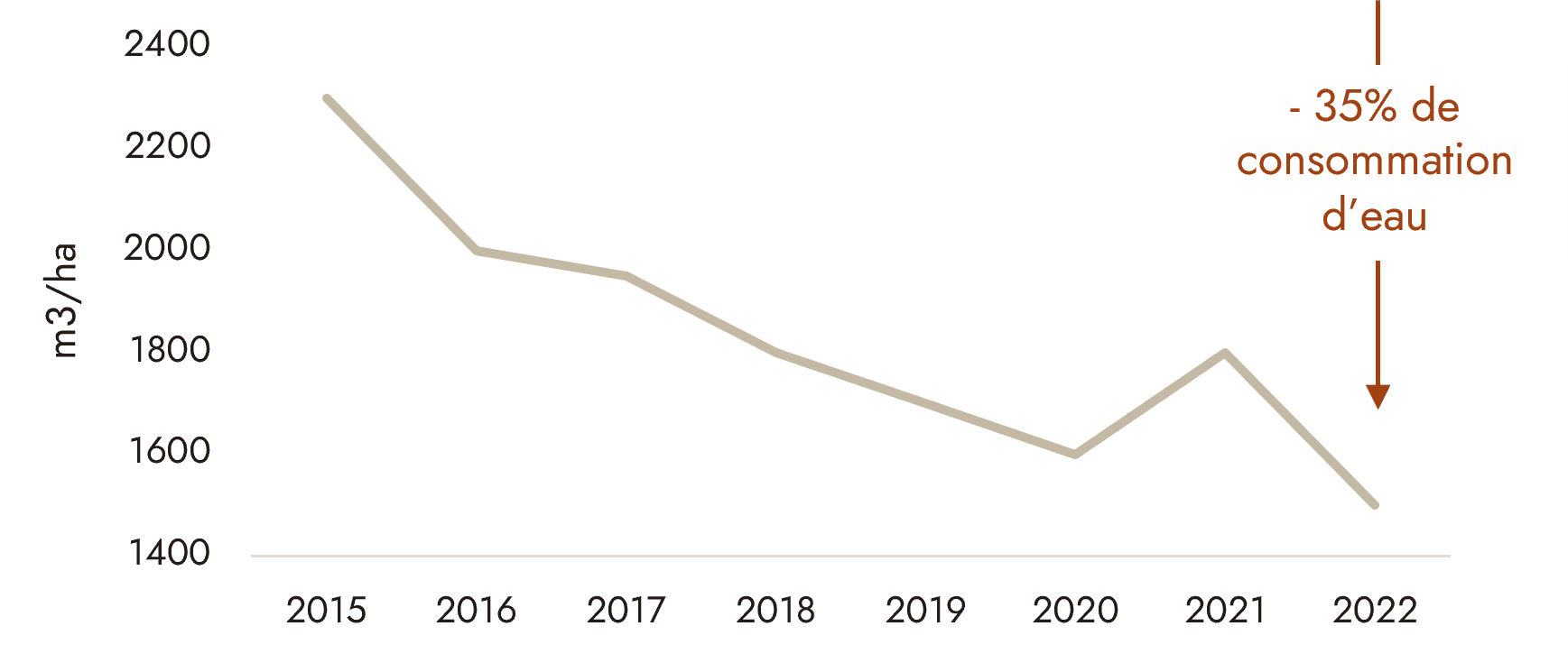
Trends in water consumption in India by Better Cotton​ surface area​

THE COST OF COTTON, SENSITIVE TO CLIMATE EVENTS​

Deux pics de prix du coton ont eu lieu depuis le début des années 2000 (cf. figure ci-dessous). A chaque fois un des facteurs clés est un choc climatique:
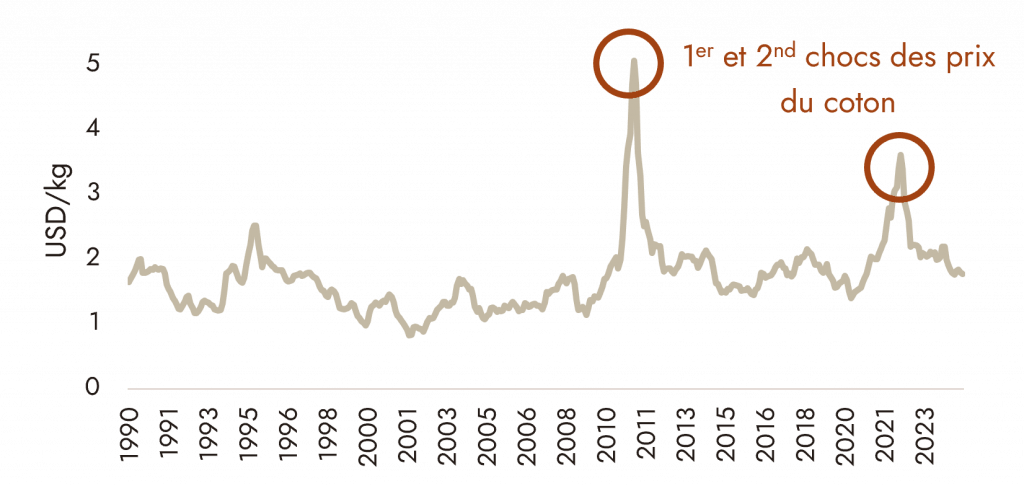
  • ​2010-2011, an all-time record: Historic flooding in South Asia (particularly India and Pakistan). Pakistan, the world's fourth largest producer at the time, lost more than 50% of its crops.​
  • ​2022: Extreme drought in Texas, resulting in the loss of approximately two-thirds of the crop in the United States, the world's leading exporter. At the same time, Pakistan suffers from excessive flooding, losing 45% of its cotton crop.

Average price of cotton fiber on the world market ($/kg)​

Extreme weather events are not solely responsible for price increases, but act as triggers or amplifiers of periods of tension, which will become more frequent in the future.

Source: Aqueduct FAOSTAT Zhang et al., 2017 (Frontiers) Wang et al., 2021 (PeerJ) ScienceDirect Revue AWM 2023 JNS_AgriBiotech_Vol_32_03 2016 Better coton – Better-Cotton-India-Impact-Report-Exec-Summary Insee – cours du marché mondial du coton PAKISTAN ECONOMIC SURVEY 2010-11